

 English
 Français
 Español
 عربى

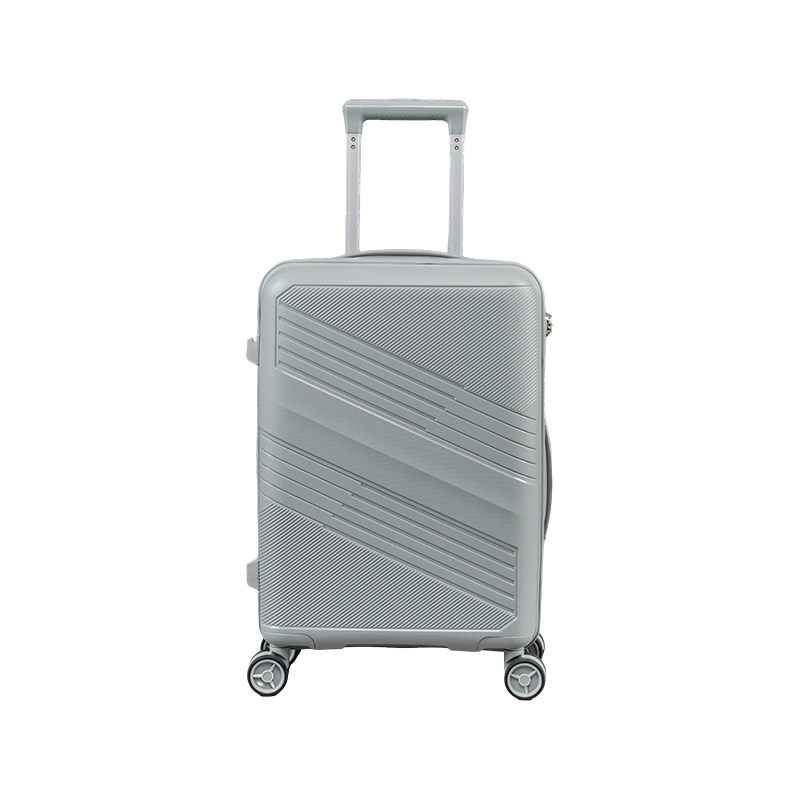
Density is the number behind a Lightweight PP Suitcase, and polypropylene has the lower of the common hard-shell plastics. Typical values are about 0.90 g/cm³ for PP, 1.05 for ABS, and 1.20 for polycarbonate. At the same wall thickness, a PP shell therefore weighs about 86 percent of an ABS shell and 75 percent of a polycarbonate one.
|
Material |
Typical density (g/cm³) |
Shell mass at equal thickness (ABS = 100) |
|
Polypropylene (PP) |
0.90 |
86 |
|
ABS |
1.05 |
100 |
|
Polycarbonate (PC) |
1.20 |
114 |
The figures are typical values, and individual grades vary a little either way.
Why the Saving Is Smaller Than the Density Gap
Equal thickness is not what a designer gets to keep. PP is less stiff than ABS and polycarbonate, and the stiffness of a flat wall rises with the cube of its thickness, so a small change in thickness moves stiffness and weight sharply. If PP were thickened until it matched ABS for stiffness, a large part of the density saving would be spent on extra material.
A Lightweight PP Suitcase is designed differently. The shell is allowed to flex, because a flexible wall absorbs an impact and returns to shape, and the design target moves from resisting bending to surviving a knock. Curved panels, ribs and reinforced corners supply shape and stiffness where the shell needs them, and the wall between those features can stay thin. The saving comes from that choice as much as from the density figure.

Shrinkage Shapes the Mould
PP is semi-crystalline. As it cools, the polymer chains pack into ordered regions, and the part shrinks more than an amorphous plastic such as ABS does. Across a large, thin shell, uneven cooling turns that shrinkage into warpage, and a warped half will not close flat against its partner.
Mould design, cooling layout and rib placement are therefore set to keep both halves flat, since the zipper line and the hinge edge depend on it. A seam that closes cleanly on a Lightweight PP Suitcase shows that the cooling was worked out as carefully as the shape.
Self-Reinforced PP Changes the Stiffness Question
Part of the stiffness gap can be closed without leaving the polymer. Self-reinforced polypropylene fuses oriented PP tapes into a PP matrix, and because reinforcement and matrix are the same material, the shell stays single-polymer and keeps the low density of the Lightweight PP Suitcase category. Glass-filled grades gain stiffness in a different way, but the added fibre raises the density and complicates recycling at the end of the case's life.
For a standard injection-moulded PP shell, thickness and ribs remain the working tools. Self-reinforced sheet is the route when a flatter, stiffer panel is wanted at low weight.
The Shell Is Only Part of the Empty Weight
The telescopic handle system, wheels, zipper, lining, locks and corner protectors all add mass on top of the shell. A Lightweight PP Suitcase is therefore specified on the whole bill of parts, not on the shell alone. Many airlines set the economy checked allowance at 23 kg, some use 20 kg, premium cabins can allow 32 kg, and fees apply above the limit, and the empty weight of the case comes straight off whichever figure applies.
Parts choices move the total as much as the material does. Spinner wheel sets and metal handle frames weigh more than fixed wheels and simple frames, and a thick lining adds weight that the traveller never sees. A weight target set for a lightweight PP Suitcase can be missed by a heavier wheel set even when the shell is exactly on target.
What the Order Can Change
For a Lightweight PP Suitcase, rib pattern, wheel type, handle system and lining can be adjusted on order, and each one moves the empty weight of the PP Luggage body. Wall thickness and ribs change the shell mass and the stiffness together, while wheels and handle systems change the weight of the assembled parts.
A grams-per-part list, kept from sample to production, lets a weight target for PP Luggage survive a change of wheel supplier or handle frame. Without it, the sample and the bulk run can differ by several parts that each look minor on their own. Weighing a sample on a scale before and after a parts change shows the difference at once, and that check costs far less at the sample stage than after a bulk run.
 Previous