

 English
 Français
 Español
 عربى
عربى
PC luggage often surprises first-time buyers.
A traveler presses on the shell and notices a slight bend. Another picks up a suitcase at baggage claim and sees one side flex momentarily before returning to its original shape. For people accustomed to very rigid luggage, these observations can feel concerning.
The immediate reaction is often the same:
"Should a hard-shell suitcase move like that?"
Interestingly, luggage engineers do not always view flexibility as a problem.
Stiff And Strong Are Not Always The Same Thing
When evaluating PC luggage, many consumers naturally associate stiffness with durability.
The logic seems reasonable. If a shell feels harder, it must be stronger.
Real-world materials do not always work that way.
In some situations, a completely rigid structure transfers force directly through the material. A shell with controlled flexibility may respond differently by distributing part of that force across a wider area.
This is one reason simply pressing on a suitcase by hand rarely tells the full story about how it will behave during travel.
Airport Pressure Comes From Unexpected Directions
Suitcases rarely experience force in a neat, predictable way.
A piece of PC luggage might be stacked beneath several other bags during loading. It may be squeezed between hard cases in an overhead compartment or pushed against the wall of a baggage container.
These situations create pressure from different angles at different moments.
What travelers often notice is not the impact itself but how the shell responds afterward. A slight temporary deformation may attract attention even though the luggage continues functioning normally.
Empty Cases Behave Differently From Packed Ones
One detail that is frequently overlooked is whether the suitcase is empty.
An empty PC luggage shell has far less internal support than one filled with clothing and travel items. This is why a suitcase displayed in a store can sometimes feel different from the same model during actual use.
Manufacturers and inspectors often evaluate luggage under conditions that more closely resemble real travel rather than judging performance solely from an empty shell.
The difference can be significant.
Temperature Can Change What You Feel
Travelers occasionally notice that luggage feels slightly different depending on the environment.
A PC luggage case stored in a hot vehicle during summer may not feel exactly the same as one removed from a cold airport cargo hold during winter.
This does not necessarily indicate a defect.
Like many engineered materials, polycarbonate responds to temperature changes. The effect may be subtle, but experienced inspectors are aware that environmental conditions can influence how a shell feels during handling.
This is one reason material evaluation is rarely based on a single moment or a single test.
Small Flexing Can Be Misinterpreted
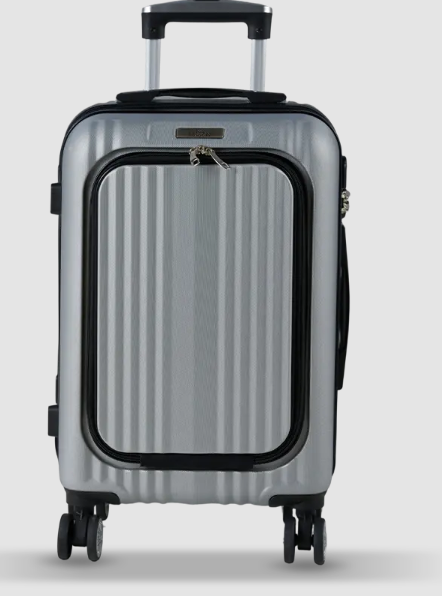
Watch people compare suitcases in a retail store and an interesting pattern often appears.
Many buyers instinctively push on the shell.
When PC luggage flexes slightly, some immediately assume the material is weaker than a more rigid alternative sitting nearby.
Yet the ability to absorb movement and the ability to resist damage are not necessarily identical characteristics.
The visible movement catches attention, while the material behavior behind that movement often goes unnoticed.
What Experienced Travelers Tend To Look For
People who travel frequently often develop a different perspective on luggage.
Instead of focusing only on how a suitcase feels in a showroom, they pay attention to how it performs after multiple trips, baggage transfers, hotel stays, and transportation changes.
For them, PC luggage is evaluated over time rather than in a single inspection.
A shell that flexes slightly under pressure may initially seem unusual. After years of travel, however, many users become more interested in how the luggage handles repeated real-world conditions than in how rigid it felt on the day it was purchased.
That is why flexibility alone rarely tells the whole story. Sometimes the more important question is not whether a suitcase moves under pressure, but how it recovers after the pressure is gone.
 Previous